


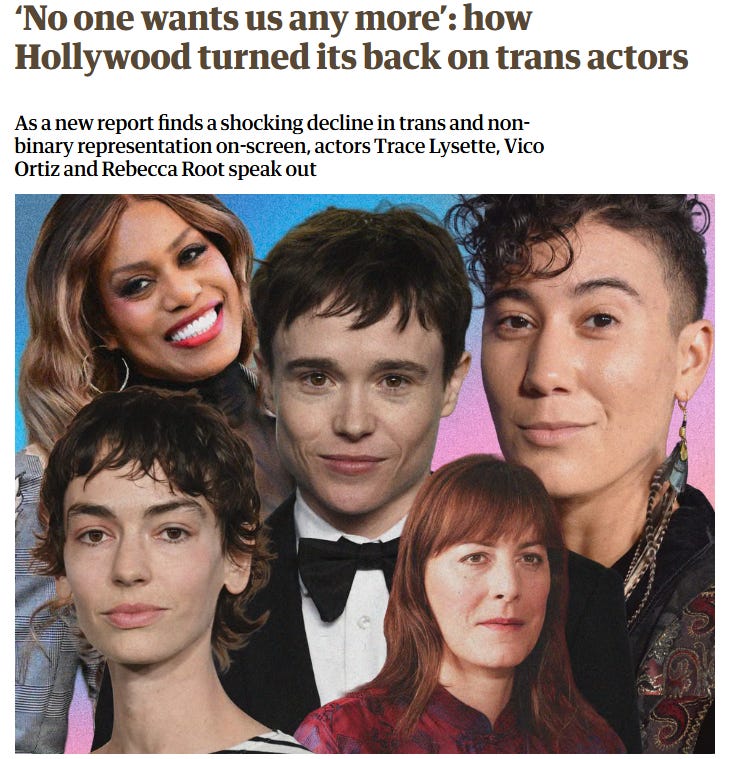
By now, you will probably have seen this Guardian headline that the number of transgender characters in film, television, and streaming shows is plummeting, according to GLAAD. Like many progressive organizations, GLAAD has long since abandoned its broader mission for ‘trans rights’ crusading.
Jason Lamphier, the author of the article, is an entertainment businessman and a senior executive and editor at Out Magazine. His coverage is meant to serve as public pressure on the entertainment industry to center transgender actors during a period of business contraction.
A deeper accounting of the trend, taken from GLAAD’s own reporting, reveals a far more complicated picture than the simplistic scenario Lamphier draws. “This plummet in representation arrives at a time when politicians and anti-LGBTQ+ activists are pushing misinformation and enacting laws and policies that threaten trans rights and safety”, he sniffs.
“Many in the industry argue that the dearth of parts for trans and non-binary performers is a kneejerk reaction to this post-Trump, anti-trans rhetoric and backlash.” One transgender actor suggests the “administration has enabled people’s implicit bias — it’s been OKed by the masses”.
Blaming the audience has been a trend in woke entertainment for over a decade. It does not work, of course — the audience will never be shamed into watching something they don’t want to see — but blaming the audience for staying home does defer the “full-on ego death” that actor Trace Lysette describes in the opening of the article.
Lysette “notes that not only are fewer trans stories being greenlit, but that transgender actors like herself who’ve scored both trans and cis roles now have little to no chance of getting either.” Take note: transgender actors are entitled to play roles of both sexes.
Contrarily, Lamphier notes an “alarmingly regressive twist” that of “two of the seven trans characters” still appearing in media “were played by cisgender men.” Take note: non-transgender actors in transgender roles is “alarmingly regressive”. In its own telling, this rule only ever works one way. It is transgender privilege.
Again, take note of what they seek. GLAAD and Jason Lamphier are very concerned that transgender actors are losing their access to Screen Actors Guild (SAG) health insurance, and with it, their “gender-affirming care”.
Why are producers, directors, and casting agents supposed to prioritize the transgender actors when their own health insurance is also on the line? Can’t the millionaires of SAG do some internal wealth redistribution, and lead us all by their progressive example, instead?
“While the industry has been producing fewer TV shows since 2022’s streaming bust and the actors’ and writers’ strikes in 2023, that alone cannot account for such a severe downturn” in transgender representation, according to Lamphier.
He is only half-right. The other half of his explanation, the wrong half, is a political program of indoctrination disguised as analysis: we will be made to enjoy transgender actors in everything, whether we like them or not, for our own edification and spiritual improvement.
WGA and SAG-AFTRA strikes certainly accelerated the decline of Hollywood, and streaming has killed both movies and television, as well as physical media sales. The other half of the actual, real, not-imaginary problem is a business cycle that Lamphier does not address.
Consider Family Law, a Canadian legal drama that aired on The CW. It starred Bobbi Charlton as Jerri Rifkin, a series regular. The show had modest ratings over four seasons and wrapped up in 2026 when its original narrative arc ended.
Squid Game, a Netflix import, was controversial for using a man to portray a man portraying a woman. Player-120 turned out to be a popular character, but the show was planned for three seasons, and ended on schedule this year, despite rave reviews and a broad fandom.
Wayward, a Netflix limited series directed by, and starring, the “nonbinary” Mae Martin alongside a ‘trans man’ police officer, ended its run as intended. Monster: The Ed Gein Story had an actor of indeterminate sex appear as Christine Jorgensen, again on Netflix, without intentions of renewal.
Two Mexican dramas, both limited series, one in Spanish, used transgender characters: The Dead Girls, in which a man plays a man playing a woman, and Unspeakable Sins, which barely rated mention in GLAAD’s report. Community Squad, a Spanish-language Netflix import from Argentina, ended in 2026 after two seasons with no sign of audience demand for more.
These shows were made throughout the period of strikes. The astute reader will have also noted these are all Netflix programs. Lamphier does not mention that Netflix just laid off 6 percent of their global workforce. Nor does Lamphier acknowledge that Netflix subscribers spend less time watching the app, and open it less frequently, than they used to.
“For investors, weakening engagement raises questions about Netflix’s ability to sustain subscription price increases, expand advertising revenue and maintain customer loyalty”, Seeking Alpha reported in October. First on the lists of concerns of the people who have the money that makes entertainment is the growth of YouTube as main-screen viewing in America. Viewers are giving up smart phone screens to watch their cat videos in the living room.
Put simply, Netflix is losing the attention of their audience, even if the audience has not yet canceled their subscriptions en masse. Netflix headquartered in Los Angeles to become a part of Hollywood, and made a bid to acquire Warner Brothers-Discovery in pursuit of that goal. It hasn’t worked.
Netflix desperately needs new IPs (intellectual properties) that might serve to win back some audience attention. To date, Netflix has failed to produce a single worthy original franchise, let alone a real hit of their own. After Paramount Skydance won the bidding war for Warner Brothers, Netflix investors began to wonder where the company would find future profits without original hits.
Netflix made too much content, and too much of it was bad. While transgender content in their children’s shows got the most attention, the real problem was too much content that nobody watched, because nobody asked for it. Netflix desperately needs a four-quadrant hit — something that attracts young people, adults, men and women — to give its brand a win.
Changes had to be made. Bela Bajaria was fired from her job as chief content officer and Dan Lin, head of film, was also let go recently after a dispute with Greta Gerwig over the direction of her C.S. Lewis adaptation. Now Variety is speculating that co-CEO Ted Sarandos intends to make a bid for NBC-Universal, the last remaining big media property on the market, in another bid for new IP to cannibalize.
Like Netflix, the transgender actor lacks a big hit, to date. Emilia Perez was received by the public as a self-satire. Elliot Page distracted momentarily from The Odyssey rather than adding to it. Her transition upended production of the Netflix sci-fi series The Umbrella Academy in season 3, as she demanded a complete character rewrite, and the show wrapped with season 4.
Now Page is complaining that no one will hire her to act as an aged boy or small man in their projects. This is not surprising, though, because a human audience simply will never stop seeing the uncanny valley when they look at Page onscreen. Shaming and berating and blaming the audience, or Donald Trump, is a cope that never alters the audience performance of the content.
And what content the transgender mind produces! In August, Andrew ‘Lilly’ Wachowski complained that Hollywood will not fund his “passion project” film, a script about transgender people under attack in a cruel, transphobic world, starring “wall-to-wall a trans cast”.
The context of this complaint matters. If the reader has ever watched Jupiter Ascending, which reportedly lost over $100 million in theatrical release, then they will already know why Lilly Wachowsky has been in ‘director’s jail’ since 2015.
The careers of both Wachowski brothers took a nosedive as sisters, and not because of transphobia, but because their content no longer resonates with normal viewers. It has become dark and deranged.
So far, no one has managed to win all four demographic quadrants with content that centers transgender characters. A transgender character can work in a show that is not about transgenderism — see Squid Game — while Christopher Nolan’s adaptation of Homer succeeded in spite of Page rather than because of Page.
Netflix has tried the ideal business model of GLAAD by centering and promoting transgender characters and actors. “Gen Z represents the largest share of moviegoers in North America”, Megan Townsend, the organization’s senior director of entertainment research and analysis, wrote in a press release this year.
The implication is that a huge audience craves this content, but that has never been the case. On the contrary, the more ‘woke’ the content, the worse it performs with audiences — because even the woke hate woke content.
Netflix tried the business model that puts transgenderism in a spotlight, and it failed. Giving up on that failure is a business decision. Activists want you to believe it is a temporary crisis of courage. It might only be temporary, but it is happening for lack of results, not lack of courage.
The next big test is Blade Runner 2099, with Hunter Schafer playing a human fugitive who secretly transitions to become a blade runner. Amazon Prime video is an entirely different topic for another day, but the show, which premieres in 9 days as I write this, is rumored to be ... well, not good. Certainly not what Blade Runner fans probably expect.
We have already seen how that kind of movie performs. If Schafer, who is probably the world’s most famous transgender actor, cannot make a franchise show a hit, then no transgender actor can. This is visible to Hollywood, and they will take note.
Hollywood Is Officially Too Broke For Woke

The Los Angeles media production job market is 30 percent smaller than it was in 2022, when credit became more expensive due to the war in Ukraine. So-called ESG (environmental, social, and governance) capital — Vanguard and Blackrock — could no longer afford to prioritize the engineering of western societies over profitability. It was the beginning of a decline in LGBTQ+ ‘representation’ and the beginning of a process that will likely result in limited reach for future rainbow-themed content. Economics, not ‘hate’, will force these changes. The trends have been underway for years already.