


I have read hundreds of war memoirs. Nearly all of them include accounts of wounding and scenes of gruesome injury. I never flinch.
To name just one famous example, Ernst Jünger was hit by enemy bullets, shrapnel, or shell fragments 14 times, requiring 7 field evacuations. His memoir of the First World War, Storm of Steel, never made my spine curl.
Reading Chalked Up: My Life In Elite Gymnastics did. What an accomplishment.
To be clear, I am praising author Jennifer Sey’s talent with words when I say that it physically hurt me to read about her injury experiences in gymnastics.
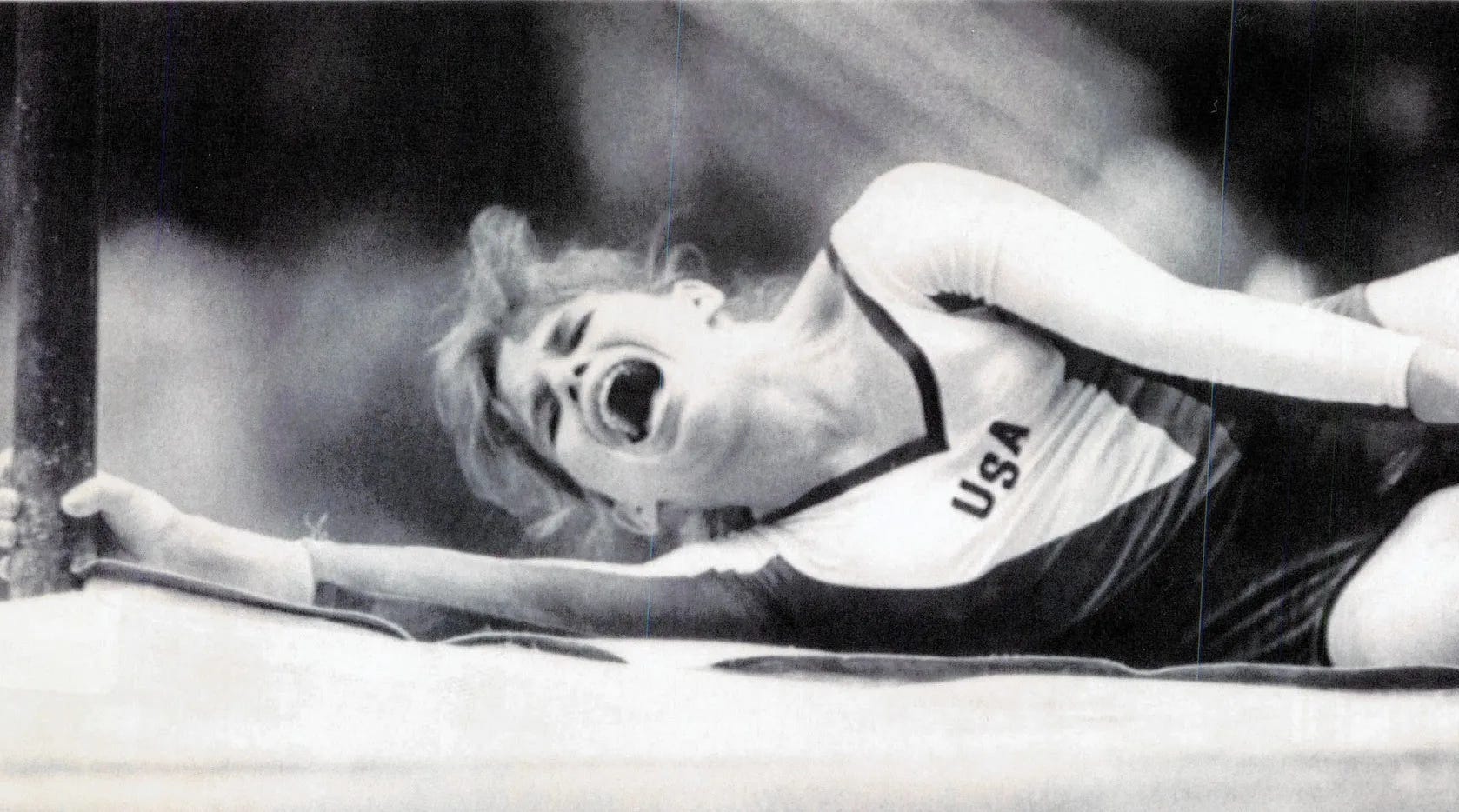
My bones felt the crunch. My head and neck felt the whiplash of the bad landing. My gut wrenched at the abuses she put her body through to make weight for the team, the coaches who pressured her to ‘play hurt’. Her injury chronicle is raw, real, felt right in the marrow. Ouch.
A different sort of pain informs her second book, Levi’s Unbuttoned: The Woke Mob Took My Job, But Gave Me My Voice.
Per the title of her sequel, Sey describes the pain of being cut off from career success in her prime. That is the core story, but it contains multitudes: the pain of regrets, the painful loss of the marriage she had at the end of her first book, the pain of labor and breastfeeding, introduced at the end of Chalked Up, that only a mother with a tortured body can know.
Her younger brother Chris breaks off contact with her in the hyper-polarized, social media-lubricated atmosphere of covid. That pain is doubled by knowing about her strained relationship with Chris from the previous book. He struggled at gymnastics as a boy, outshined and outranked by his sister. The new rupture in their relationship is a re-injury, a recall of the ankle that never healed.
Read as a single memoir, the most painful wounds are the self-inflicted ones, the self-criticisms. Jennifer Sey has no mercy on herself. Her body and soul each take more hits than Jünger, and all at her own instigation.
Every self-wound burns like fire, stings like venom. Her brutal honesty is honestly brutal, which makes her indictment of other people, and of her sport, even more compelling. The pain they inflicted on her is left without excuses.
Gymnastics was too much of a good thing. Completing a feat instilled confidence in her, at first, but then it became a daily routine of facing down her anxiety. “By junior high school, many of the girls I’d trained with were burned out”, she writes in Chalked Up. “The daily fear of injury was an exhausting strain, and for many, it was just too much to take.”
It proved too much for Sey to take, eventually. Injuries and pressure and too few calories led to gym burnout, so that competitive success was followed by training collapse. Coaches were instrumental in this process. They forced girls to do ever-more dangerous stunts, lose more weight, train with injured limbs.
By comparison, her brother Chris was never under the same pressure. None of the boys were. Gymnastics delayed Sey’s puberty and left her painfully image-conscious, themes that resonate with dysphoria. Sey regrets a cosmetic breast reduction when she breastfeeds: she knows something of the pain that ex-trans mothers feel.
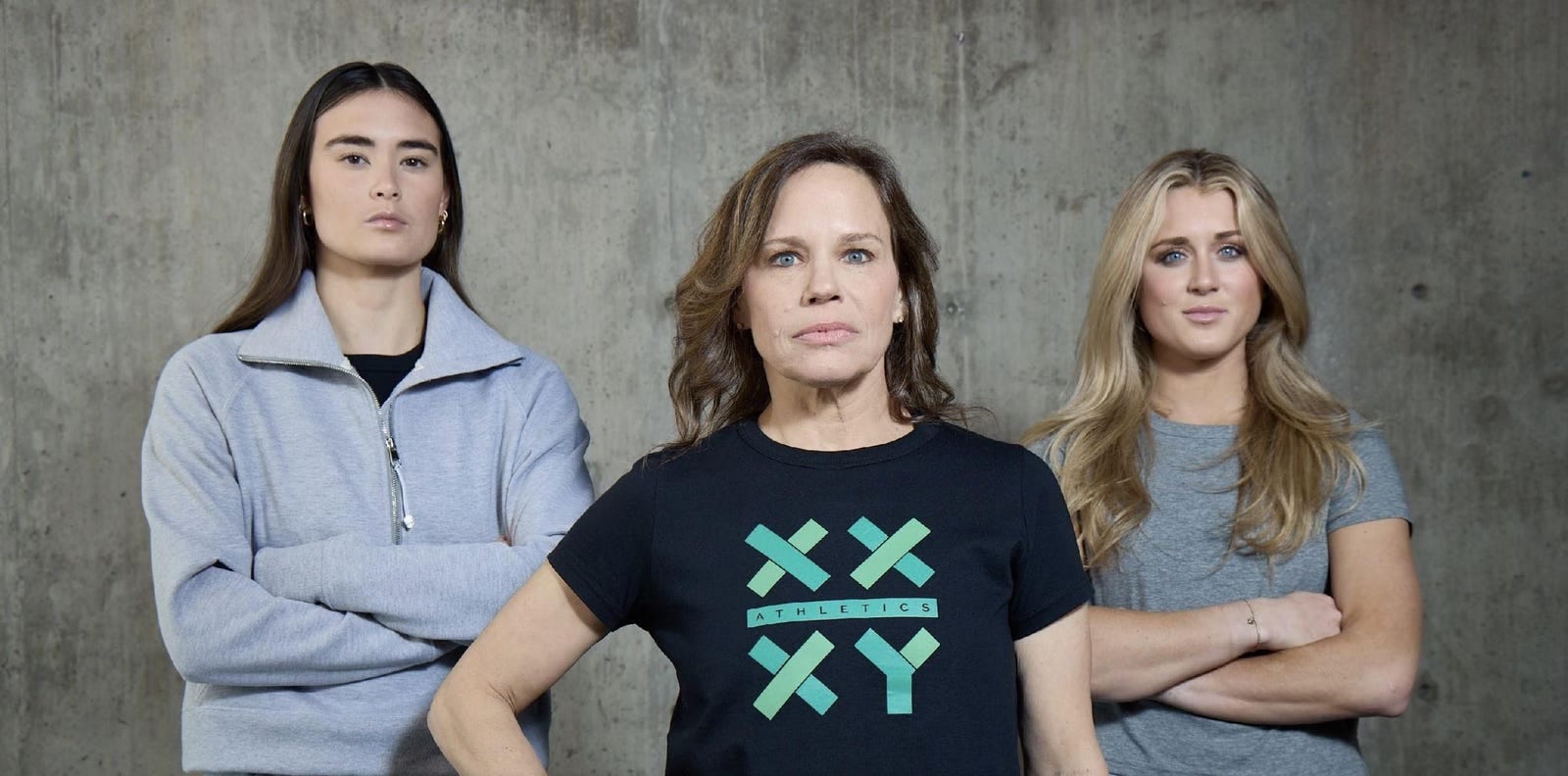
Jennifer Sey has become controversial for her XX-XY Athletics brand. It is her third act, perhaps worthy of a third memoir. While sports are her life and the basis of her brand, Jennifer Sey clearly has compassion and understanding for what many girls are going through when they adopt transgender identities.
They are looking for the brand that fits, and that kind of marketing is Sey’s specialty.
“My first pair of Levi’s were baby blue corduroys that I wore with pride until they were floods, several inches above the ankle (this is before cropped was cool, they were just too small).”
Style notes about jeans are not random in the second memoir. Sey is explaining what makes a brand a brand, something that people will wear to announce who they are. Everyone wants to look great in their jeans, but women especially want their butts to look good. Sey did not fight this ‘male gaze’ at Levi’s. She proudly and successfully exploited it, she tells us.
Mentorship is a theme in both memoirs. Chalked Up has Lois (‘Lolo’), “warm and grandmotherly, almost fifty when I met her”, who becomes a refuge for Sey. Lolo is just about the only coach that ends up looking good in the book.
Levi’s Unbuttoned on the other hand has Dominic, who spots her talent early. Turn the page, and Jean Jackson, CEO of Banana Republic, is focusing Sey’s ambition to become a chief marketing officer.
“It was 1995, and she was the last corporate leader who would express unconstrained support for what I wanted from my career. She was also the only leader I’ve worked under who was so forthright about who we really served” — the shareholders — “and why we were actually in business at all.”
Moving up, Sey describes the social environment at The Gap as she found it, explaining why she walked out of it. Then she walks out of her first marriage.
“Mean girls gone mad best described the culture”, she writes of The Gap. “Conspicuous consumption ruled the hallways” as female executives wore expensive labels and handbags.
Sey was unsatisfied with her husband, too. “I mention this part of my life only because quitting is a theme in my narrative”, she writes. Sey did not want to share his starving artist lifestyle anymore.
Indeed, this is another continuous theme from Chalked Up, her story of quitting gymnastics before it killed her: Sey will walk right out of any soul-crushing situation.
Between the two books, there is a continuous thread of inter-female competition. “Angie was destined to become my best friend, my fiercest competitor, my alter ego”, her frenemy in gymnastics. “Other girls could beat me, but it only needled when Angie did.”
Sey’s first “talking to” at Levi’s came from Kelley McGinnis, head of Corporate Communications. “Our partnership had been somewhat strained in the early days when I was a new CMO”, Sey speculates. “With only a few slots reserved for women at the executive level, weren’t we all in competition to ascend the ladder?”
Sey did not share this form of toxic femininity, though she understood it. She “took special care to mentor women” in her role and writes that women made great mentors and collaborators throughout her time at Levi’s.
In fact, Sey’s politics were discernibly left, liberal, progressive, and concerned with racial justice, as late as 2020. Her account of the death of George Floyd is the mainstream media telling of the story.
Whatever her opinion on the controversy is today, Sey has left a snapshot of what she believed before and after she was canceled, and it turns out that she was rather woke.
She does not explain her ‘gender critical’ turn in Levi’s Unbuttoned, for it came later. We do see her mind changing, though.
It happened with covid. McGinnis played the key role in Sey’s ouster, which began with the “talking to” about her opinions on social media.
Sey wanted the public schools to reopen. Her colleagues, McGinnis included, had children attending private schools in person already while the public schools remained closed in the Bay Area. Sey could see at-home “learning” devastate her own son and worried that minority kids would suffer learning deficits.
Sey was an Elizabeth Warren voter. The issue was radicalizing her. Had Levi’s left her covid heresies alone, Sey might have remained a loyal Democrat. They could not leave her alone, however.
Woke capitalism was changing the company culture. Levi’s was already taking a public stand against the first Trump administration and considering a public stance on gun control. The company youth cadre could not leave Sey alone after she dared to appear on The Ingraham Angle. Right wing! Racist!
Nor could they leave her second husband’s social media accounts alone. Sey observes that “one of the seven signs you’re in a cult is that the cult asks you to cut off contact with any nonbelievers.” Daniel “was the enemy, and I incurred guilt by association.” A woke mob was forming.
At the time, companies were mistaking market noise for signal. Many brands still are. Nike has depreciated in market cap by forgetting who its customers are. Levi’s too was hearing noise and interpreting it wrongly as market signal.
Rather than sign the NDA and take the money, Sey walked away and told her story. This too is consistent with her gymnastics career.
Chalked Up drew criticism for broaching the taboo topic of pedophile coaches when it was published in 2006; then it won praise when the Larry Nassar scandal proved her right. That episode was forgotten again when Sey was canceled for having wrong opinions about covid that turned out to be right.
Now she is subject to cancelation for having wrong opinions about female sports, namely that males should not be included in them. The woke mob is fickle.
Jennifer Sey does not explain sex difference scientifically. She describes it as she found it: coaches pushing girls’ bodies too hard, favorable scoring by judges for girls they favor, constant shaming about their weight.
What seems normal inside a cult looks insane to those outside it. “I had broken my femur, one of the largest and strongest bones in the human body, nearly in two” at a competition in Montreal. Sey was relieved, for she had thought it was a knee injury, which would be a harder recovery.
“Everyone gathered around my bed in the recovery room and we celebrated. It seemed likely I’d do gymnastics again.”
“It’s not your knee!” John cheered.
“It’s only broken!” Mrs. Strauss rejoiced.
Decades later, the memory of pain still lingers in her joints. The bone chips that went unremarked and unremoved from her ankle while she struggled through the pain have left a permanent hurt. She left her mark on Levi’s, but the pain of losing her ‘work family’ still stings in the pages of her memoir.
Heresy led to heresy. In her X and Substack posts, Sey ties youth gender medicalization to the broader erasure of sex-based categories, including sports. She attended the 2025 Genspect conference to speak on the role of woke capital in the shape of public discourse. It is companies, not the government, which decide whether your social movement is acceptable enough to be allowed to speak.
In the epilogue of Levi’s Unbuttoned, Sey rejects any return to corporate leadership on such terms. Her athletic brand is an act of radical resistance, though she is hardly anti-capitalist.
“XX-XY Athletics” carries its message in the name. To take issue with the brand message is to argue against reality. The late American political scientist William H. Riker coined the term heresthetics for this kind of communication.
Jennifer Sey’s brand sets the agenda and controls the referendum on its own meaning. It is her very own corporate communication, built on an intimate understanding of what women and men each want. After reading her books, I must say the brand looks very good on her.
Legacy Media Struggles To Explain How The Trump Admin Is Shutting Down Gender Clinics

“At least six major hospitals have agreed to refuse gender-affirming hormones and surgery for transgender young people and agreed to make payments to the federal government, according to deals with the Department of Justice”, Associated Press reporter Geoff Mulvihill