
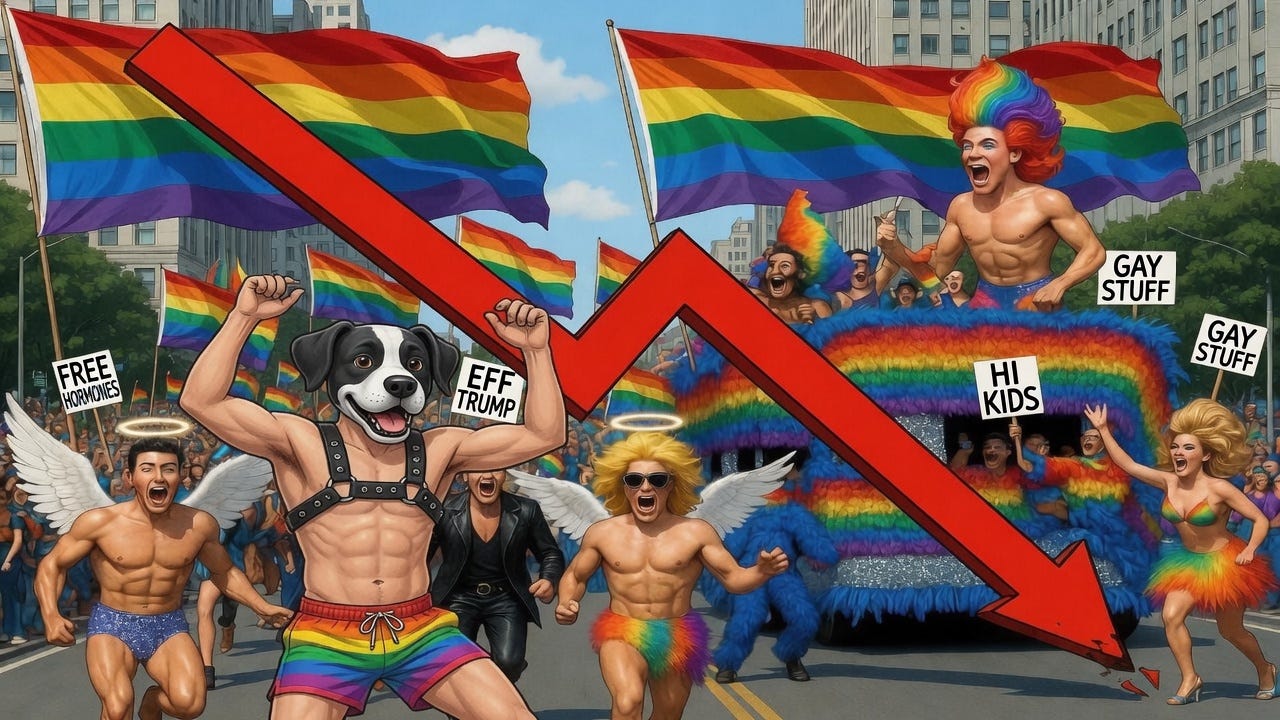
Pride Goeth Before A Fall In Public Approval
Collapse of public event organizing accelerates
The collapse of Pride was already visible in 2025. In 2026, the air going out of the rainbow bubble is so visible that it cannot be denied by anyone. The most visible thing about Pride month anymore is that it passes with less fanfare, and more controversy, than ever.
According to one recent report, Pride events that used to draw tens of thousands of people have been canceled in Tampa, Florida; Arlington, Texas; Tucson, Arizona; and Ashtabula, Ohio “due to hostile political climates, funding issues, volunteer shortages, and safety fears.”
Sponsors and past participants both increasingly see attendance at Pride events as “potentially dangerous”. One sponsor “was heartbroken to tell me that he couldn’t support. And not only could he not support by writing a check, but he also couldn’t have a presence there,” says Becke Powell, executive director of Ashtabula Pride, who blames “hatemongers”.
Corporate image managers in particular began to cut back on ‘woke’ sponsorships during 2025. They weren’t simply responding to the ‘vibe shift’ of Donald Trump’s second term. Pride aesthetics were already an established brand-killer by the end of 2024. ‘Woke is broke’, and the writing was on the wall.
Things are worse now. NPR, which is the state radio network of the queer nation, noted in May that “Pride celebrations across the country continue to lose out on large sponsorships as corporations, a key source of funding, shrink their affiliation with diversity causes and LGBTQ+ events.”
Organizers of Pittsburgh Pride estimate they will take in “30-40%” of the funds they were able to raise just a few years ago. Individual donors and state grants — taxpayer largesse — have become important new sources of funding.
In Florida, Tampa Pride announced a one-year hiatus after a slew of corporations dropped their sponsorships, said Carrie West, who ran the organization.
“All of a sudden, bingo. Here you have no money, no grant money, no supporting money, to make operations, to plan, to get any kind of anything,” he said. “Oh my gosh, it was, it’s devastating.”
Speaking of devastation, let us recall that Adrian Mardell had to step down as CEO of Jaguar last July because one Pride-themed advertisement wrecked their brand. Coming on the heels of the Bud Light fiasco, in which Dylan Mulvaney’s mug destroyed a beloved beer brand that has still not recovered, corporate America has learned that the public does not want Pride in its products.
“Federal contractors are in a particularly precarious place when it comes to Pride, because Pride is so closely integrated into broader DEI efforts,” an organizer says about WorldPride, which was smaller than usual this year.
Perhaps that is because it was held in Washington, DC, land of federal contractors. “And I think for a lot of companies celebrating Pride just comes a little too close to the danger zone where the administration might be targeting them on DEI more broadly.”
Two things can be true at the same time: the politics of Pride can be bad, and the marketing optics of Pride can be bad at the same time. In fact, this combination is worse, from a brand perspective.
The Pride brand was sold to corporate America as a safe virtue signal. It has proven toxic to other brands. It will still prove brand-toxic elsewhere.
WorldPride still had a big party, of course, because America is in fact still the land of the free. Everyone had a good time. No one was actually oppressed by the Trump administration.
The organizers, Capital Pride Alliance, planned more than 300 events over the course of three weeks beginning in mid-May, including dance parties, films, Drag Story Hour, events for LGBTQ military personnel and, one of the key features of past WorldPrides, a human rights conference. The big closing ceremony this weekend includes a parade and a concert with a massive lineup of performers that includes a “Global Dance Party” with Jennifer Lopez, plus another concert featuring Cynthia Erivo and Doechii.
Madonna held a pop-up event in a crowded Times Square to promote Pride, as well as her new album. Her own brand is unlikely to suffer from association with Pride. Doechii, whoever that is, will probably not have a hard time because of this performance.
Musicians are not car companies or beer companies. They are still not giving up on Pride as long as it remains non-toxic to their careers. But that time may coming soon. Pride month faces increasing community resistance at schools, even in very liberal places like Ottawa. Outside of our cultural elites, the acceptability of Pride has continued to decline, year on year.
Of course, our cultural elites are not blind. They understand that public acceptability of gay and lesbian relationships has slipped from a high of 71 percent down to 62 percent in just a few years. Rather than take a second look at Pride, and reconsider their public approach, elites and their institutions too often double down on forced speech.
These episodes are becoming more visible all the time. Three relief pitchers for the San Francisco Giants wrote bible verses on their baseball caps this weekend during the LGBTQ+ Pride Night game. Major League Baseball has sent them all a warning letter about “defacing” their uniforms, which on this very special night included a Pride logo on the caps.
For anyone old enough to remember when quarterbacks could get politicians to take a knee in the end zone and score progressive political points, it is strange to see the same media outlets that hyperventilated about politics in sports now excoriate these players for daring to deface their holy Pride hats.
In recent years, America has seen the phenomenon of rainbow street crossings that receive special police protection from vandalism with paint and tire marks. These are no longer crosswalks — in fact, they confuse service animals and police horses and likely violate disability access laws. They are now holy sites of joyous public celebration. Be joyous, and repent. Also press your accelerator smoothly, you bigot.
Defacement of holy Pride hats and holy Pride crosswalks is a crime that must be punished in the court of public opinion as well as actual courts. Blasphemy brings on the cancel mobs. Organized, well-heeled special interest groups will show up waving progress flags, pretending to speak for a ‘community’, demanding ‘accountability’.
The relationship between Major League Baseball, a hypermasculine institution, and Pride goes back to a 2002 Los Angeles Dodgers game in which two lesbians were ejected for kissing.
It should go without saying that both lesbians were women. In 2026, Pride rejects the idea that the word ‘lesbians’ should imply that two people are both female.
“Baseball is for Everyone”, the League announced. Like Stonewall, the British gay rights organization which transformed into a transgender rights organization, this Pride presence within MLB has become something different than it was a quarter-century ago. Gender identity is the entire difference.
In America, two men ought to be free to kiss at a Dodgers game and call themselves lesbians. That is freedom. The reader may disagree with my statement, “ought to be free”, because the reader is free to disagree.
In current America, everyone is obliged to celebrate two men kissing at a Dodgers game and call both men lesbians. Disagreement is not allowed. It is impolite, or rather impolitic. A taboo. This is oppression.
These two Americas exist side-by-side in a quantum state because Pride is not what it used to be. Politics are the only thing keeping Pride alive, now. Rather than freedom, Pride is chiefly a dependency: right wing bogeymen will supposedly genocide the gays unless we give puberty blockers to the kids.
It is a pale, rancid replacement for American civic religion with constitutional values, and so Americans increasingly reject it.
Meanwhile, the reputational risks inherent to the Pride brand grow over time. By April 2025, Pride event organizing had reportedly lost about 40 percent of its funding on both sides of the Atlantic. This has only gotten worse, according to the Pride organizers themselves.
The public image of Pride organizing has taken a number of hits in the last year. During 2025, Stephen Ireland, the co-founder of Pride in Surrey, was found guilty of raping a 12-year-old boy he had met on Grindr.
During the trial, a British court learned that Ireland and his partner, David Sutton, referred to themselves as “pedos” and fantasized about feminizing their victims with hormones and surgeries. Unsurprisingly, Surrey organizers have called off Pride for 2026, citing a decline in corporate sponsorship.
Since then, Samuel Winbridge, aka ‘Kizzy Lavender Lee’ (real name Samuel Wimbridge), the founder of Newbury Pride in the UK, has been charged with sex offenses against a girl under 13.
During January, Ashley Boyd, “Trans liaison” to an NHS trust and Chair of Swindon Pride, lost his nursing license for “unnecessary” and “sexual” examinations of children. In Canada, the founder of Innisfil Pride was convicted of seven sex trafficking charges last month.
The market is checking out of this high-risk activity even as the institutions remain in thrall to the special pleading of Pride. MLB is doing very well these days — their viewership and stadium attendance are up — but then again, Bud Light used to be a beloved beer brand, too.
The Pride brand is not what it was. The Pride brand is no longer received by the public the same way it was ten years ago. On both sides of the Atlantic, an increasing number of people see Pride as something more sinister than just adults behaving badly.


