


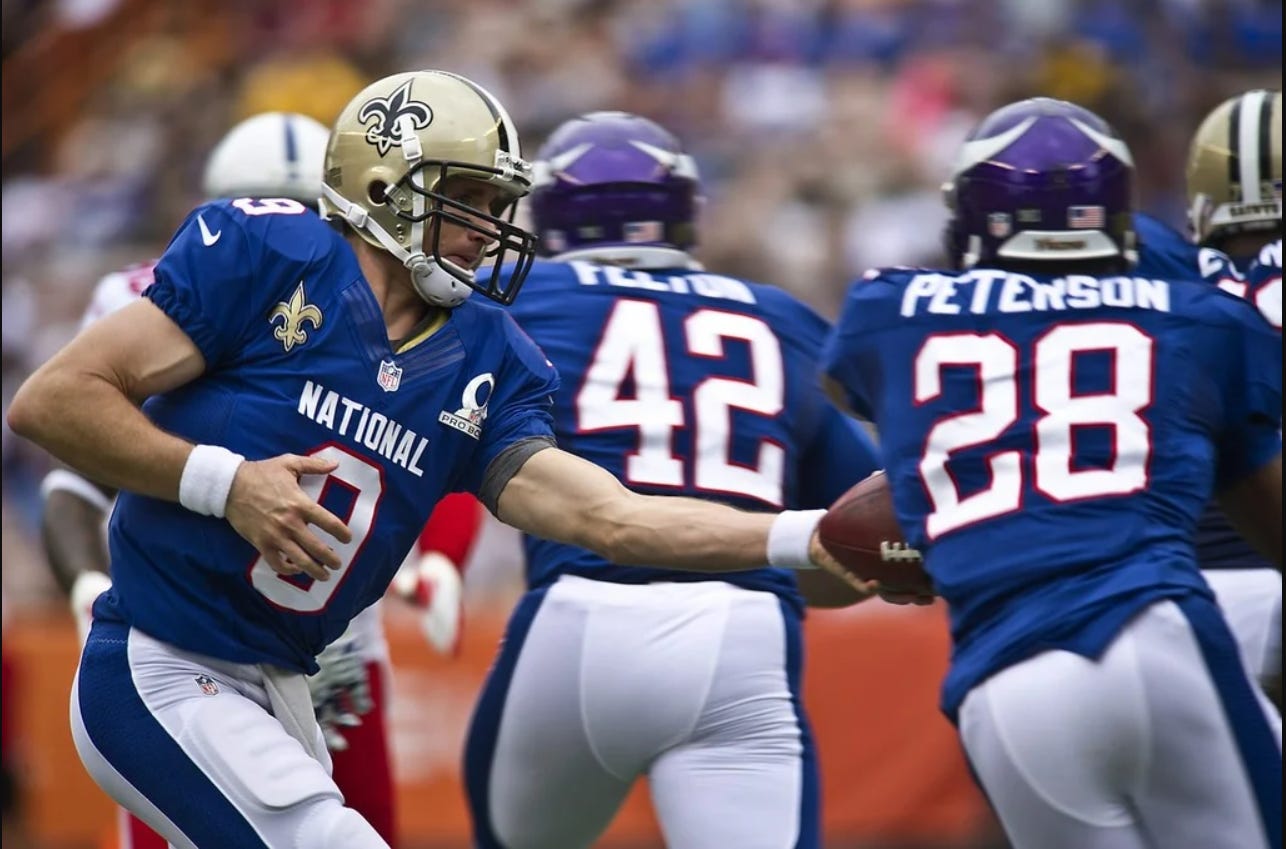
Zero women have ever made an NFL roster, completed a training camp, or made a regular-season appearance on the professional football field with men. Every single person who has ever played a single actual snap in the history of the National Football League was male. Females have always been extremely rare at all levels of the game, but in the biggest professional league, they are nonexistent.
During the late 1960s, there was a Women’s Professional Football League, but it was a “gimmick” by talent agent Sid Friedman that ended in 1973. More to the point, those women played on all-female teams. The larger heart, lungs, bones, and muscles that boys have before adolescence, that develop during puberty, give men severe advantages against women on the gridiron.
One need only look at the men around the ball on every play to see it. Offensive linemen are chosen for their ability to sustain blocking, achieve leverage, and exert power. They average 6’5” (195 cm) in height and 310 lbs (140 kg) in weight, whereas at most, there are few dozen to a few hundred women worldwide, probably fewer than 50–100 in the United States, who are that tall and heavy.
Elite female rugby players are probably the best comparison group to offensive linemen in football, and they average just 5’7” (170 cm) and 184 lbs (83 kg). For this reason, none of the women who have ever played football on male teams has been an offensive lineman — or a defensive lineman, for that latter.
Sex difference completely explains the absence of women in tackle football. No other explanation holds up under rigorous examination. Women simply cannot compete with men for almost any position on a professional team. In fact, women have a very difficult time just competing with adolescent boys. ‘Patriarchy’ and ‘misogyny’ play no role whatsoever in this phenomenon. It is biology.
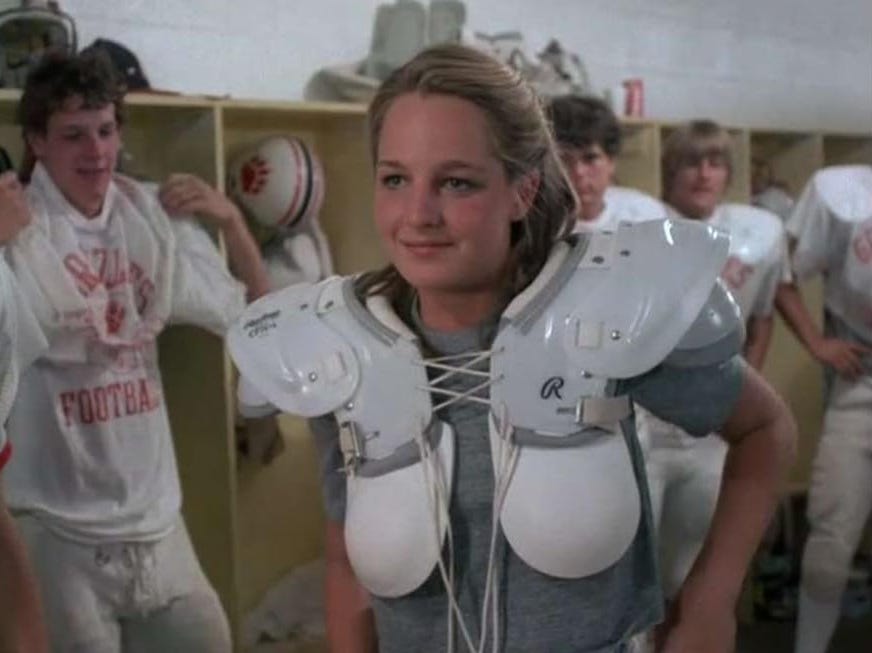
Girls in football are a novelty
Tami Maida was 14 years old when her family moved from British Columbia to Oregon in 1981 so that she could try out for the boys’ junior varsity football team at Philomath High School in Oregon. Maida had a very supportive family, especially her father, but she was also at the very end of her youthful athletic competitiveness versus boys her own age.
By happenstance, there was no boy on the team with her evident leadership skills or her passing accuracy. Despite some community opposition, Maida succeeded brilliantly — for just one season of JV football.
Then Maida went home to British Columbia with her family. That was it. She played herself in the CBS movie, filling in for star Helen Hunt in many of the game sequences, but Tami Maida never played a real game of high school football again.
It is difficult to blame her, for varsity tackle football was a brutal game in the 1980s. I know because I was there. Tami Maida could not have continued her success indefinitely and she knew it. She was already taking hits on almost every play, she said, and the boys would only get bigger and stronger as juniors and seniors.
In one scene, Hunt’s character confronts her boyfriend, played by John Stockwell, for getting into a fight with an opposing player who was flagged during a game for hitting her after the referee’s whistle.
TAMI: Listen, I don’t need you sticking up for me, alright? If I can’t take my hits out there like everybody else, I shouldn’t be out there.
SCOTT: No but you’re a girl, isn’t that what you said?
TAMI: Yes, but not when I’m playing.
SCOTT: Well, what are you, then?
TAMI: What do you mean, “What am I”?
SCOTT: Maybe putting on all those pads makes you forget that you’re a girl. I know what’s underneath.
TAMI: Look when I’m playing … When I’m not playing, I, I’m a girl, yes. But when I’m playing I’m not … a male, exactly, but I’m not … not a girl, either.
Maida was elected homecoming queen. Her teammates bought her dress for the event. She was definitely a girl. Today, however, Tami Maida would likely be encouraged towards a ‘nonbinary’ or transgender identity. She would be told that her interest in football makes her a boy, that she is in the wrong body and needs to be fixed.
In fact, girls simply do have the wrong bodies to compete with boys at football during adolescence, the very moment when all players are developing the skills that might take them to the college or professional game. No amount of family or community support can change the hard decisions that evolution, or God, made long ago about human biology.
Female football players are rare enough, but Tami Maida was unique for playing quarterback. Despite rules to protect them, quarterbacks are subject to hard knockdowns and tackles throughout the game. Maida was lucky that no boy in Philomath, Oregon had intact knees and better throwing skills — and she still had to admit that her quarterbacking days were done after one season.
It is not actually surprising that Maida chose quarterback, however. Females tend to fill ‘skills positions’ in football when they do play with males. Antoinette ‘Toni’ Harris played wide receiver and cornerback on the boys’ varsity team at Redford Union High School in Michigan. Harris was the second woman to ever receive a scholarship to play football in college. She said the NFL was her goal, but she never got close.
During 2018 and 2019, Harris played free safety at East Los Angeles College. It is a junior college, not a Division I, II, or III team. Harris got very little time on the field and recorded exactly three tackles and one tackle for loss during two seasons. Central Methodist University, an NAIA school in Missouri, then gave Harris a full-ride scholarship as a safety.
During the 2020 and 2021 seasons, however, Harris saw no game time and recorded zero tackles, interceptions, or other stats, despite remaining eligible and on scholarship the whole time. No woman has ever had a genuinely successful career in the men’s game.
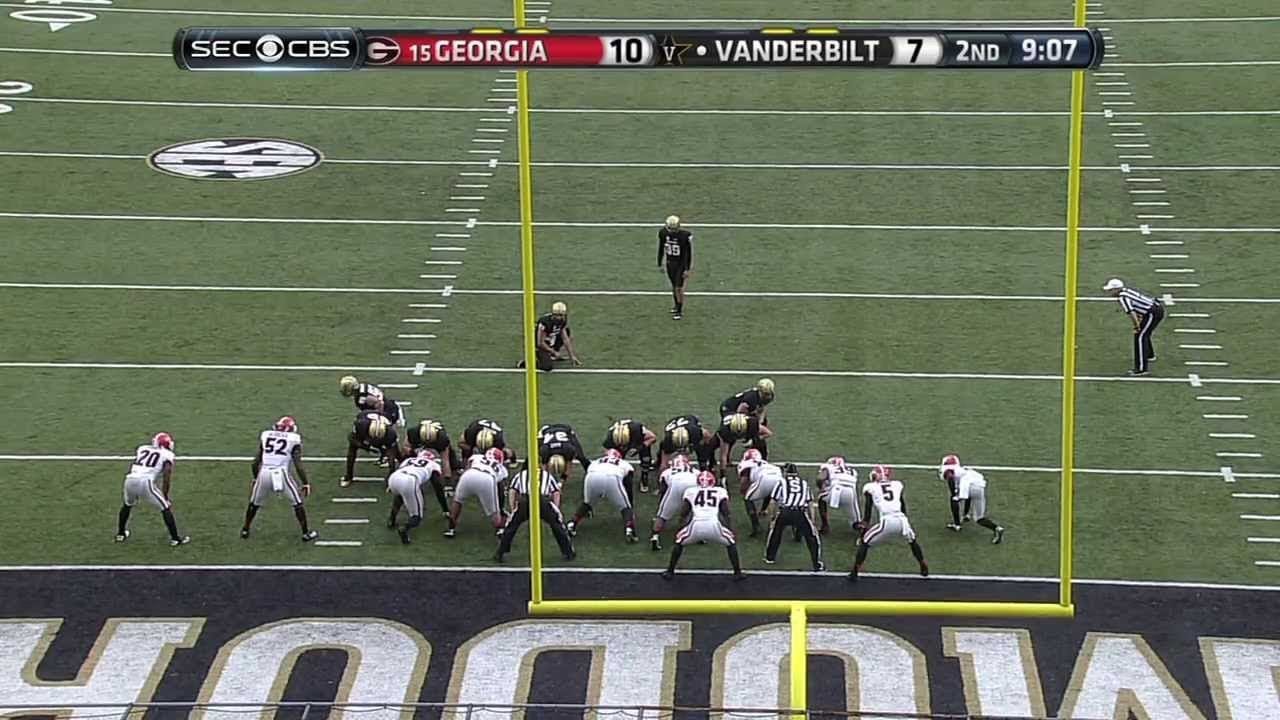
Why placekicker is the most common position for women
ONE: At 5’5” and 120 pounds, Liz Heaston was never going to fill any position on the field except placekicker. A soccer star, she joined the Willamette University Bearcats in 1997 as their backup placekicker. Heaston made history on 18 October 1997 when she filled in for the injured first-string kicker against Linfield College, converting two extra points in a 27-0 victory, becoming the very first woman to ever score in a collegiate football game.
Her football career was extremely brief, appearing in just two games, missing her other two extra point attempts and never attempting a single field goal. This is the pattern for female placekickers, the most common position women have tried to fill on men’s teams. In every case, soccer was the woman’s first sport.
TWO: Becca Longo made 35 out of 38 point-after-touchdown (‘extra point’) attempts and converted her one field goal attempt at 30 yards as a senior on the Basha High School team in Chandler, Arizona during 2016. Longo signed a national letter of intent with Adams State University in Colorado, becoming the first woman to earn a college football scholarship at an NCAA Division I or II school.
Longo did not play her first season in 2017, being kept in reserve (‘redshirted’). The next year, she suffered an ankle injury and left Adams State without ever attempting a single kick of any kind. Her on-field NCAA record is zero games played and zero kicks attempted. Longo then joined the Gila River Hawks, a junior college team in the newly formed Hohokam Junior College Athletic Conference, but she recorded no stats there.
THREE: Leilani Armenta set five Ventura County football records during her junior and senior high school seasons in 2021 and 2022. Attending Jackson State University, a historically black campus, on a soccer scholarship, Armenta debuted on the Division I football field with a kickoff against Bethune-Cookman on 23 September, 2023. Five weeks later, she converted three extra points in a 40-14 victory, again after the first string kicker had been injured.
Armenta added one more extra point in 2024. She had converted all four of her extra point attempts in college, but attempted no field goals, when she graduated. During 2025, she signed a contract with the Mississippi Panthers of the Women’s National Football Conference (WNFC), a professional minor league that started up in 2019, when the NFL was in its 99th year of operations.
FOUR: In November 2020, amid a COVID-19-related kicker shortage at Vanderbilt, 6’2” (188 cm) tall Sarah Fuller joined the football team as a placekicker. On 28 November that year, she became the first woman to play in a ‘Power Five’ game in the Southeastern Conference with a second-half kickoff.
It was a squib kick, a kind of trick play in which the kicker deliberately makes the ball bounce along the ground instead of fly through the air. Fuller was able to try and convert two extra point attempts on 12 December against the Tennessee Volunteers. However, Vanderbilt lost the game 42-17. Like all of these women, Fuller ended her brief career without a single field goal attempt.
FIVE: The most famous female placekicker of all time is Lauren Silberman. She had never played competitive football at any level, in fact she had only been kicking a football for a couple of months as a new hobby, when she tried out for the NFL in 2013 at the age of 28.
Lauren Silberman participated in an NFL regional scouting combine at the New York Jets’ practice facility, becoming the first woman to compete in any official NFL tryout event. She attempted just two kickoffs, neither of them impressive at just 19 yards and 13 yards, before a quadriceps injury ended her tryout. While her performance drew significant media attention, with nearly two dozen outlets present at the scene, Silberman’s NFL career was over before it began.
We have now covered the very brief football careers of one quarterback, one defensive back, and five placekickers who were female. This position is one of the most protected on the field, with special rules that punish even incidental contact by defending players under normal circumstances. Kickers do the least running, blocking, and tackling of any position in football, indeed they only ever come on the field a few times per game. Yet even here, we find that women have never been competitive with men on the gridiron. Men’s football is a man’s world.
These days, women’s football has also become a man’s world, unfortunately.
